What is Cardiorespiratory Fitness?
Cardiorespiratory fitness represents how well your heart, lungs, and blood vessels work together to supply tissues like muscle with oxygen-rich blood. We now know cardiorespiratory fitness is inversely correlated with all-cause mortality1 meaning the more fit you are the lower likelihood of death from all causes. VO2 max is the gold standard representation of your cardiorespiratory fitness and reflects sustained and progressive exercise activity over years.
What is VO₂ Max?
VO2 max is defined as the maximum rate at which your body can consume oxygen during exercise. It represents the maximum oxygen transport of your cardiorespiratory system and the aerobic efficiency of your skeletal muscle, both of which can be trained. The actual VO2 max number will be a double digit with the unit mL/kg/min — for example (45 mL/kg/min). What this means is you are consuming 45 milliliters of oxygen divided by your weight in kilograms per minute.
How is it Measured?
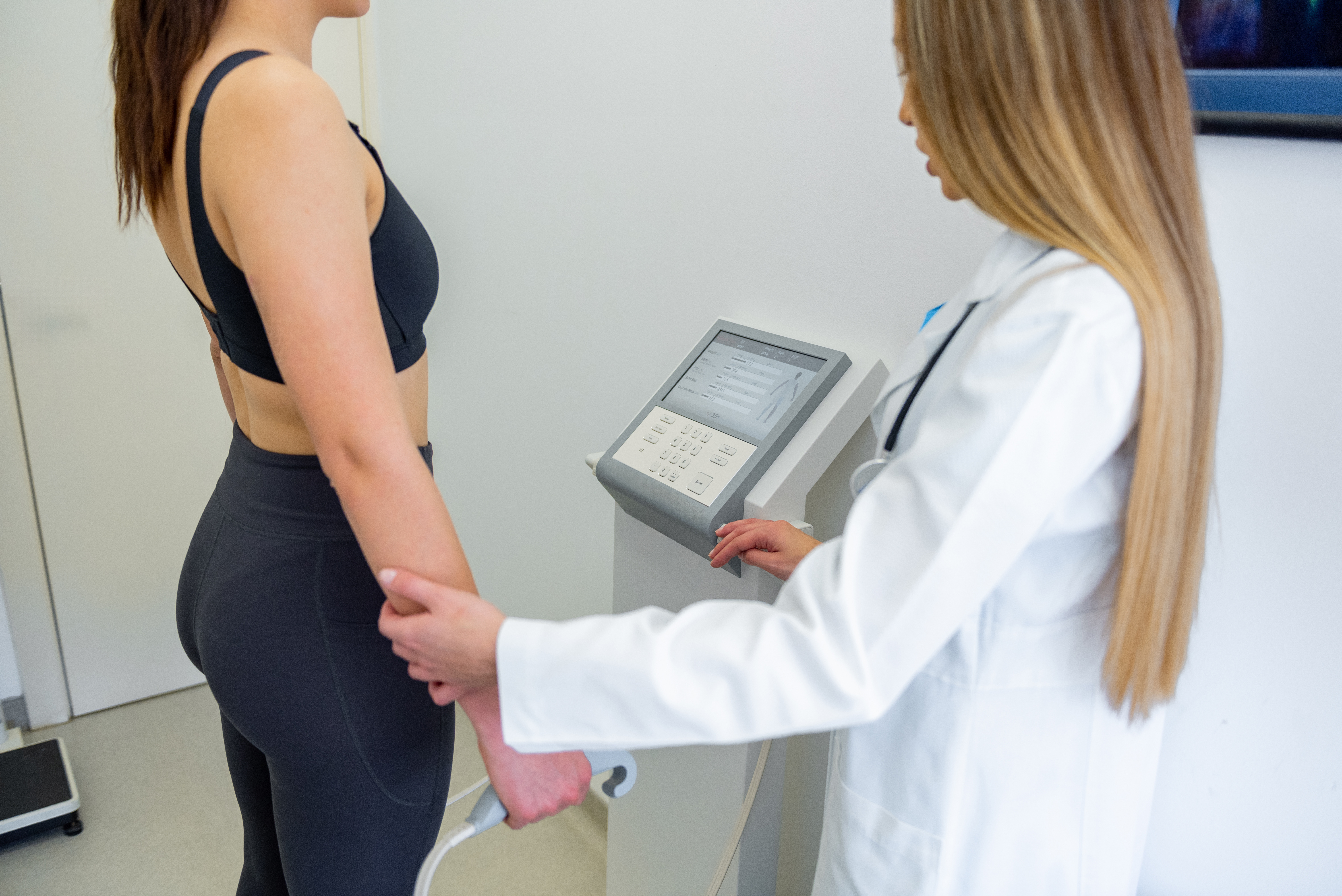
You can measure your VO2 max directly in a physiology lab by performing a progressive intensity exercise test usually on a treadmill or stationary bicycle while wearing a facemask attached to a metabolic cart — a specialized computer that measures both oxygen consumption and carbon dioxide production. This test is inherently difficult as you need to reach close to maximum heart rate for the best results and can sometimes be hard to find a provider to perform the test. For these reasons, many modern wearable brands like OURA®, Garmin®, and Apple® provide VO2 max estimates based upon your heart rate dynamics and pace data. You may find what category your VO2 max falls into on the chart below by navigating to the correct gender and age bracket.
VO₂max normative data — Female (values in mL/kg/min)
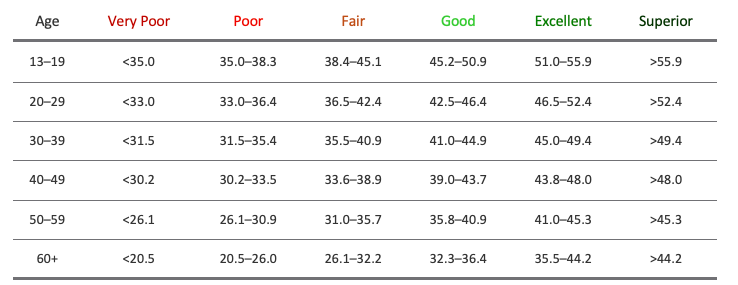
VO₂max normative data — Male (values in mL/kg/min)
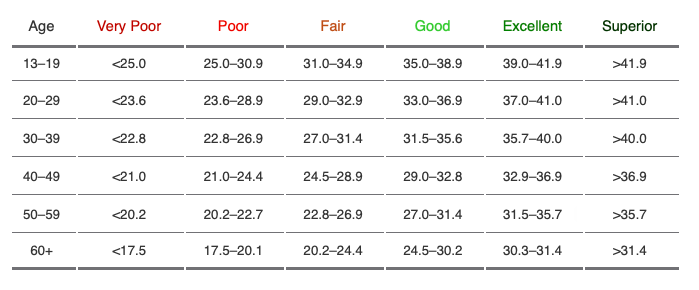
Source: The Physical Fitness Specialist Certification Manual, The Cooper Institute for Aerobics Research, Dallas, TX (1998).
Improving Your VO₂ Max
Your VO2 max number is highly modifiable so do not be discouraged if it is currently lower than expected. Even brisk walking of ~150 minutes per week can have large improvements in cardiorespiratory fitness if you are not currently exercising2. There is a dose-response relationship between increases in cardiorespiratory fitness and reductions in all-cause mortality and heart failure3, meaning even seemingly small increases in VO2 max may provide large reductions in disease risk. Ask your clinician if you have questions about VO2 max and walk/run/bike/swim your way to a healthier you.
*References
1. Kokkinos, P., Faselis, C., Samuel, I. et al. Cardiorespiratory Fitness and Mortality Risk Across the Spectra of Age, Race, and Sex. JACC. 2022 Aug, 80(6) 598–609.2.
2. Garber CE, Blissmer B, Deschenes MR, et al. American College of Sports Medicine Position Stand. Quantity and quality of exercise for developing and maintaining cardiorespiratory, musculoskeletal, and neuromotor fitness in apparently healthy adults: guidance for prescribing exercise. Med Sci Sports Exerc 2011;43:1334–1359.3.
3. Lang JJ, Prince SA, Merucci K, et al. Cardiorespiratory fitness is a strong and consistent predictor of morbidity and mortality among adults: an overview of meta-analyses representing over 20.9 million observations from 199 unique cohort studies. Br J Sports Med. 2024 May 2;58(10):556–566.